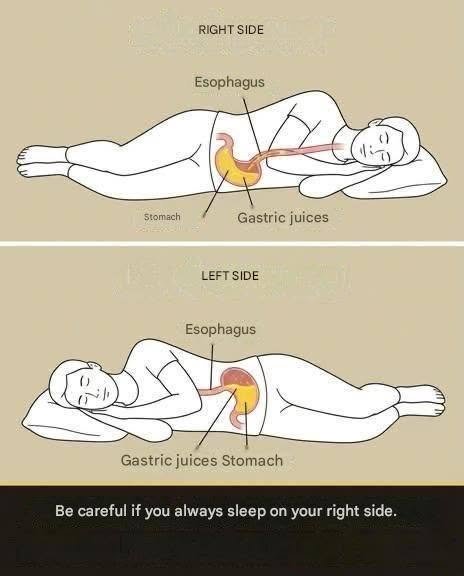
If you always sleep on your right side, it can have a few distinct physiological impacts on your body due to internal anatomy and gravity:
-
More frequent acid reflux: Because of the way the stomach is shaped and positioned relative to the esophagus, sleeping on your right side relaxes the lower esophageal sphincter and makes it much easier for stomach acid to leak upward, triggering heartburn. (The left side, by contrast, keeps the gastric junction above the level of gastric acid).
-
Potential impact on heart comfort: While healthy adults generally tolerate either side well, people with certain heart conditions or heart failure often find that sleeping on the right side increases the sensation of a racing or uncomfortable heartbeat, as gravity shifts the heart slightly within the chest cavity.
-
Shoulder and hip pressure: Consistently crushing one side of your body night after night can concentrate pressure on your right shoulder and hip, leading to localized joint stiffness, soreness, or even arm numbness if circulation is restricted.
-
Facial wrinkles: Continuous side-sleeping presses half of your face firmly against a pillowcase, which can accelerate the formation of sleep lines and wrinkles on that specific side over time.
On the positive side, side-sleeping in general is great for keeping your airway open (reducing snoring compared to back sleeping), and most people naturally shift positions throughout the night anyway.