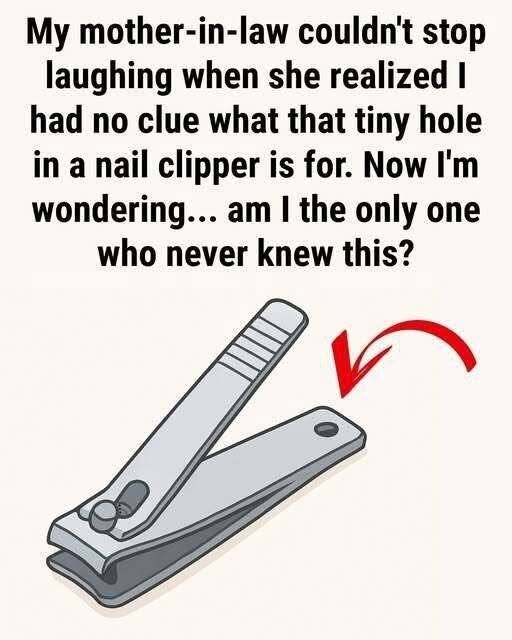
Why does a nail clipper have that small round hole?
That little round hole on a nail clipper looks insignificant, but it can serve several practical purposes depending on the design.
1. It can be part of the lever mechanism
A standard nail clipper has two cutting jaws and a lever that you press with your thumb. The lever pivots on a small pin or post, multiplying the force you apply.
The hole or opening you see in the metal lever is often related to how the lever is formed, assembled, or positioned around the pivot mechanism. It helps manufacturers produce a lightweight piece of metal that remains sufficiently rigid.
2. It can make the clipper easier to carry
On many clippers, a hole is deliberately positioned so that the clipper can be attached to a key ring, chain, lanyard, or small accessory.
This was especially useful when personal grooming tools were commonly carried in small travel or military kits. A clipper attached to a ring was less likely to get lost.
3. It can reduce weight without sacrificing much strength
Nail clippers are usually made by stamping and bending thin metal. Removing a small amount of material can reduce weight while retaining the strength needed for normal use.
This is an example of a simple engineering principle: material doesn’t have to be solid everywhere to be strong enough for its job.
4. It isn’t normally a secret sharpening or cleaning feature
You may see claims online that the hole is designed for sharpening the clipper, opening bottles, removing splinters, or performing some other hidden function.
Those explanations aren’t universal. Nail-clipper designs differ, so the exact purpose of a particular hole depends on where it is located and how that model is constructed.
Why does it still matter today?
Modern nail clippers haven’t changed their basic mechanical principle very much because the design is already cheap to manufacture, compact, durable, and effective. A simple lever provides enough mechanical advantage to cut fingernails and toenails without requiring a large tool.
So that tiny hole is a reminder that everyday objects often contain small design features that serve manufacturing, structural, mechanical, or carrying purposes—even when their function isn’t immediately obvious.