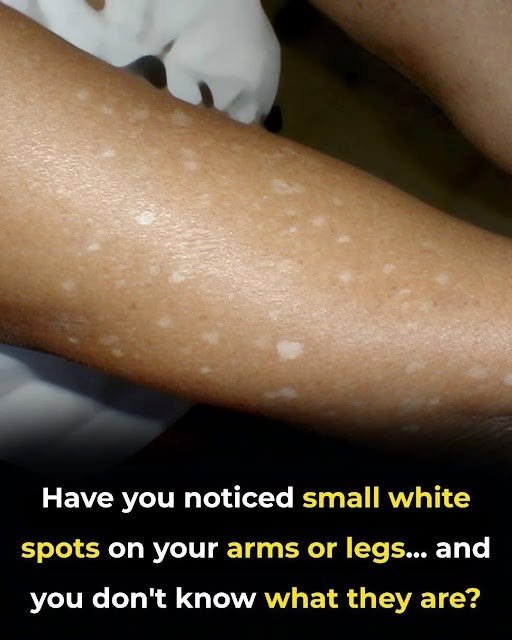
Small white spots on the arms or legs are common and can have several causes. They aren’t necessarily a sign of a serious illness.
Common possibilities
- Idiopathic guttate hypomelanosis (IGH): Small, flat, pale-white spots, often a few millimeters in size, commonly appearing on sun-exposed arms and legs. They’re especially common with increasing age and long-term sun exposure.
- Tinea versicolor: A superficial fungal infection that can produce lighter—or sometimes darker—patches. It may have fine scaling and is more common on the trunk, neck, and upper arms.
- Vitiligo: Smooth, clearly lighter patches caused by loss of pigment-producing cells. Spots can gradually enlarge or appear in other areas.
- Post-inflammatory hypopigmentation: A lighter area that remains after a rash, injury, burn, or other skin inflammation has healed.
- Dry skin or other dermatologic conditions: Scaling and irritation can sometimes make skin appear temporarily lighter.
When should you get it checked?
See a dermatologist if the spots are rapidly spreading, becoming completely white, itchy or scaly, painful, bleeding, or accompanied by other skin changes. A clinician can usually narrow down the cause by examining the pattern and, when necessary, using tests such as a Wood’s lamp or skin scraping.
Don’t assume white spots mean a vitamin deficiency. Although nutritional deficiencies can affect the skin, they aren’t the most common explanation for small, localized white spots.