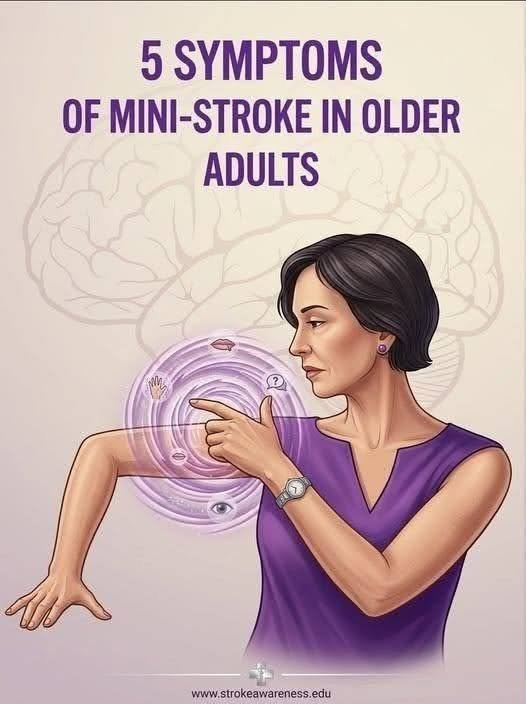
Viral health articles warning about “mini-strokes” often use dramatic language to capture attention, but a mini-stroke—medically known as a Transient Ischemic Attack (TIA)—is a genuine medical emergency.
Unlike a full stroke, a TIA occurs when blood flow to a part of the brain is temporarily blocked, causing stroke-like symptoms that typically resolve within a few minutes to 24 hours. Because the symptoms disappear quickly, people often brush them off as fatigue, dizziness, or “getting older.” However, a TIA is a critical warning sign: up to half of all people who have a major stroke experience a TIA beforehand, often within the following days or weeks.
Recognizing the subtle or overt warning signs in seniors can save a life.
The 5 Key Symptoms of a Transient Ischemic Attack (TIA)
Using the well-known FAST acronym alongside other sudden neurological shifts helps identify when a mini-stroke is happening:
-
Sudden Facial Droop or Numbness
-
The sign: One side of the face suddenly droops or feels numb. If you ask the person to smile, the smile is uneven or one corner of the mouth refuses to lift.
-
-
Sudden Weakness or Numbness in an Arm or Leg
-
The sign: Weakness or a heavy, clumsy feeling down one entire side of the body (e.g., an arm drifting downward when trying to hold both arms up, or a sudden limp).
-
-
Sudden Slurred Speech or Difficulty Finding Words
-
The sign: Speech that sounds garbled, thick, or slurred, or a sudden inability to understand what others are saying or form coherent sentences.
-
-
Sudden Vision Changes in One or Both Eyes
-
The sign: A sudden darkening, blurring, or partial loss of vision in one eye, or double vision that comes on without warning.
-
-
Sudden Severe Dizziness, Loss of Balance, or Confusion
-
The sign: A sudden, overwhelming bout of vertigo, unsteadiness, or feeling completely disoriented, especially when paired with any of the signs above.
-
Why “Transient” Does Not Mean “Harmless”
Because a TIA resolves on its own and leaves no permanent physical damage, many seniors (and their families) assume the danger has passed. This is a dangerous misconception.
Think of a TIA as a “minor earthquake” before a major tremor. It signals that a blood vessel in the brain is narrowed or that a clot has temporarily formed and broken loose. The underlying cardiovascular risk factors—such as high blood pressure, atrial fibrillation, high cholesterol, or carotid artery disease—are still active and require immediate medical intervention to prevent a catastrophic, permanent stroke.
What to Do Immediately
-
Treat Every TIA as a Full Stroke: If an older adult experiences any of these symptoms—even if they completely disappear after five minutes—call emergency services (911 or local emergency numbers) immediately.
-
Note the Time: Keep track of the exact time the symptoms first appeared. If doctors decide to administer clot-busting treatments or perform diagnostic imaging, knowing the timeline is critical.
-
Do Not Wait It Out: Never advise someone to “lie down and sleep it off.” Prompt evaluation in an emergency room allows doctors to run an urgent brain scan (CT or MRI) and vascular imaging to initiate preventative medications, such as blood thinners or antiplatelet drugs.