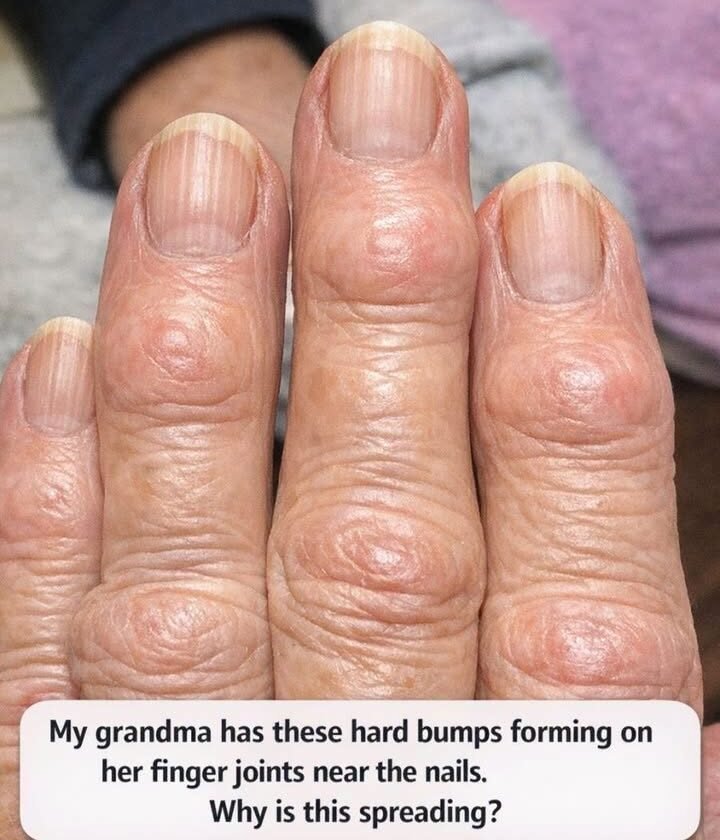
Hard, bony bumps developing on the finger joints nearest the nails are very common, and seeing them appear on multiple fingers can feel concerning.
### Why Are They Forming and “Spreading”?
When bumps form near the fingernails, they are typically one of two related things—both of which tend to affect multiple joints over time:
1. **Heberden’s Nodes (Bony Spurs):** If the bumps feel hard like bone, they are likely Heberden’s nodes. These are small bony growths that form on the joint closest to the fingertip (the distal interphalangeal joint) as a result of **osteoarthritis**. As the cartilage inside the joint gradually wears down over the years, the body responds by producing extra bone at the edges of the joint. While it can feel like they are “spreading” from finger to finger, this is usually just the natural progression of hand osteoarthritis, which frequently runs in families and affects multiple digits symmetrically or sequentially.
2. **Digital Mucous Cysts:** If the bumps look a bit more like shiny, smooth, or fluid-filled nodules right next to the nail bed, they are often mucous cysts. These are closely linked to the same underlying wear-and-tear arthritis in the joint. Small amounts of joint fluid escape and form a pocket under the skin, which can sometimes press against the nail matrix and cause a small ridge or bump to form on the nail itself.
### What Your Grandma Can Do
* **Consult a Doctor:** It is a good idea for her to have a primary care provider or a rheumatologist evaluate her hands. A simple physical examination or an X-ray can confirm whether osteoarthritis or another joint condition is the cause.
* **Manage Discomfort:** During the active phase when these nodes are first forming, the joints can occasionally become tender, warm, or swollen. Gentle heat (like warm compresses or paraffin wax), over-the-counter topical anti-inflammatory gels, or wearing a supportive splint during flare-ups can help ease discomfort.
* **Avoid Popping Cysts:** If any of the bumps are mucous cysts, **never try to puncture or drain them at home**, as this carries a high risk of introducing a serious joint infection.