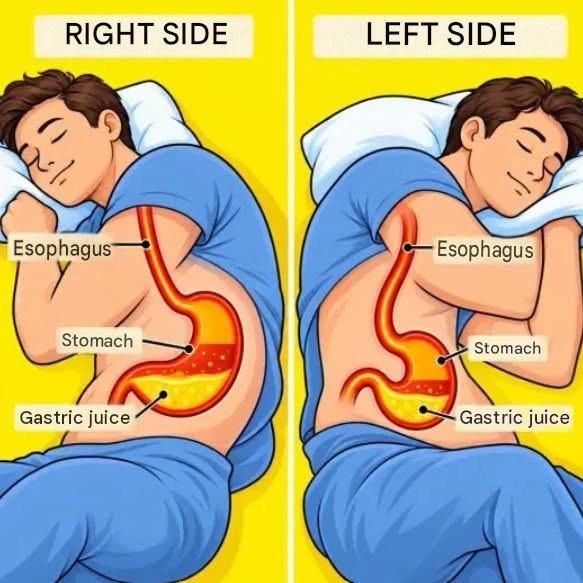
That headline captures another classic wellness cliffhanger—pitting sleeping positions against your health and hinting that your nightly posture might be secretly sabotaging you.
Internet articles love to declare one sleeping position as an absolute villain and another as a miracle cure. When it comes to sleeping on your right side, the physiological reality is a mix of genuine anatomical impacts and harmless sleep preferences.
What Sleeping on Your Right Side Actually Does
Your internal organs are not symmetrically arranged, meaning the side you choose to snooze on genuinely interacts with your anatomy:
-
Increased Risk of Acid Reflux (GERD): This is the most scientifically backed drawback of right-side sleeping. Your stomach sits on the left side of your abdomen, and the gastroesophageal sphincter (the valve that keeps stomach acid down) sits just below the level of the esophagus. When you lie on your right side, the gastric acid sits higher than that valve, making it much easier for acid to leak up into the esophagus. (Left-side sleeping keeps the stomach below the esophagus, using gravity as a natural barrier against reflux).
-
Heart Strain (Mild, for Specific Populations): While a healthy heart doesn’t care which side you sleep on, individuals with congesthe heart failure or certain heart conditions often report feeling uncomfortable or experiencing palpitations when lying on their left side because the heart shifts slightly. Conversely, some doctors suggest right-side sleeping for heart patients to reduce pressure on the chest cavity, though overall comfort usually dictates the best choice.
-
Pregnancy Considerations: During pregnancy, doctors strongly recommend sleeping on the left side. This prevents the heavy uterus from pressing directly against the inferior vena cava—the large vein running along the right side of your spine that returns blood from your lower body to your heart. Lying on the right side can compress this vein, reducing cardiac output and blood flow to the fetus.
-
Skin and Wrinkle Impact: Whichever side you press your face against all night experiences constant mechanical compression. Over years, side sleeping (on either the right or left) contributes to “sleep lines” and facial wrinkles due to the skin being squished against the pillowcase.
When to Change Your Position
You don’t need to panic if you wake up on your right side, but you should consider shifting positions if:
-
You suffer from frequent heartburn or GERD: If you wake up with a sour taste in your mouth, a burning chest, or a chronic cough, switching to your left side (or elevating the head of your bed) can provide dramatic relief.
-
You are pregnant: Always favor your left side with a pillow between your knees for optimal circulation.
-
You wake up with shoulder or hip pain: Prolonged pressure on one hip or shoulder joint can pinch nerves and restrict blood flow, causing stiffness. Adding a body pillow can help take the pressure off.
Ultimately, your body naturally shifts positions multiple times a night. Comfort and pain-free waking are usually much better guides than rigid sleep-position rules!