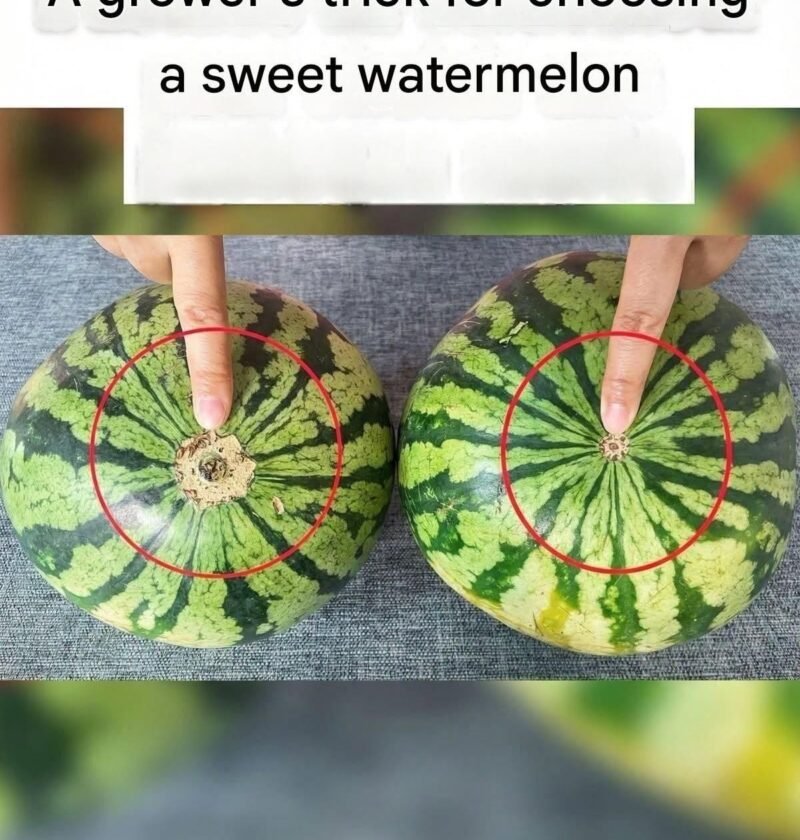
🍉 No More Bland Watermelons: How to Pick a Sweeter One
There’s no visual method that can guarantee sweetness, but a few clues can improve your chances of choosing a ripe, flavorful watermelon.
- Look for a creamy yellow field spot. This is where the watermelon rested on the ground. A well-developed yellow or yellow-orange spot is generally a better maturity clue than a completely white one.
- Choose one that feels heavy for its size. This usually indicates plenty of water and a juicy interior.
- Prefer a duller rind. A very shiny green rind can be less useful as a maturity clue; a dull, slightly less glossy appearance is often preferred.
- Check for a symmetrical shape. Avoid melons with major bruises, soft spots, cracks, or irregular sunken areas.
- Don’t obsess over webbing. Brown web-like markings aren’t a reliable guarantee of sweetness.
- Don’t depend on the “thump test.” A hollow-sounding watermelon is often recommended online, but listening to the sound is subjective and isn’t a dependable measure of sugar content.
🍉 The easiest rule to remember
Yellow field spot + heavy for its size + firm, intact rind = a good starting point.
Once cut, keep watermelon refrigerated and don’t leave cut pieces at room temperature for extended periods.
Bottom line: You can’t see the sugar level through the rind, but choosing a heavy watermelon with a well-developed creamy-yellow field spot is more useful than relying on viral tricks.