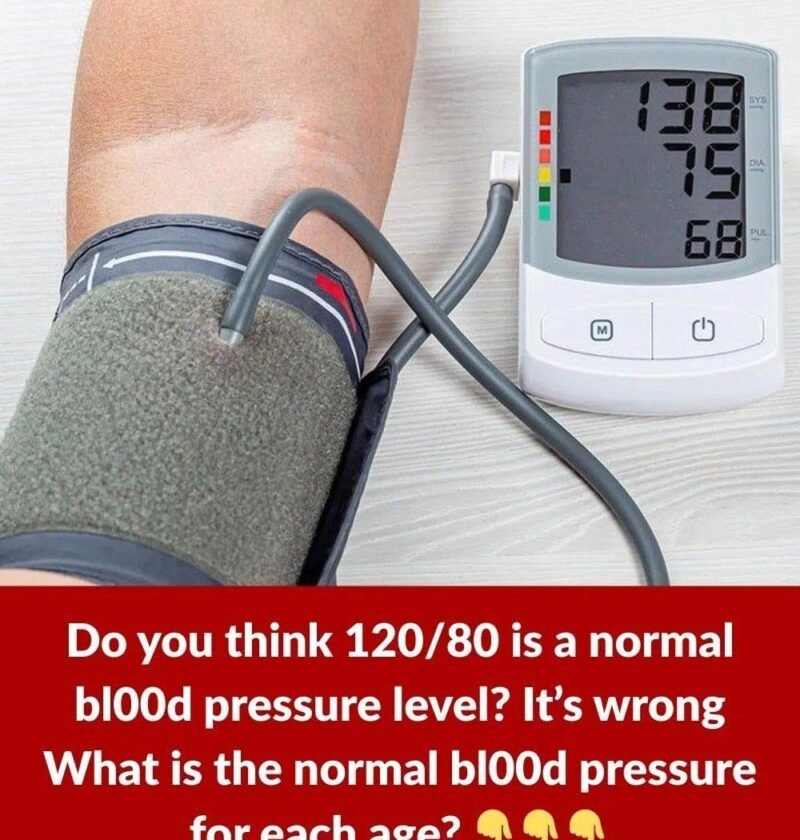
When looking at blood pressure by age, it helps to separate **medical guidelines** (what is considered healthy) from **population averages** (what people actually measure as they grow older).
According to major clinical guidelines (such as the American Heart Association and the American College of Cardiology), **the definition of normal blood pressure does not increase as you get older.** For all healthy adults, the ideal target remains the same.
—
### 1. Adult Blood Pressure Categories (Ages 18 and Older)
For any adult, a standard blood pressure reading consists of two numbers: **systolic** (the top number, measuring pressure when the heart beats) and **diastolic** (the bottom number, measuring pressure when the heart rests between beats).
| Category | Systolic (mmHg) | | Diastolic (mmHg) | What it Means |
| — | — | — | — | — |
| **Normal** | Less than 120 | **and** | Less than 80 | Ideal target for all adult ages. |
| **Elevated** | 120–129 | **and** | Less than 80 | Tends to worsen over time if lifestyle changes aren’t made. |
| **Stage 1 Hypertension** | 130–139 | **or** | 80–89 | High blood pressure; often managed first with lifestyle adjustments. |
| **Stage 2 Hypertension** | 140 or higher | **or** | 90 or higher | Clearly elevated high blood pressure requiring medical management. |
—
### 2. What Changes with Age? (Average vs. Healthy)
While the *target* for a healthy heart stays below 120/80 mmHg throughout life, **population averages naturally drift upward as people age.** This happens because blood vessels and arterial walls naturally lose some of their elasticity over time (arterial stiffening).
Consequently, what is *common* at a certain age is not necessarily the same as what is *optimal*:
* **Young Adults (18–39 years):** Average readings often hover around 110–120 / 70–78 mmHg. Younger adults frequently run lower, particularly women prior to middle age.
* **Middle Age (40–59 years):** Averages gradually climb to around 120–130 / 74–82 mmHg. This is the decade where blood pressure frequently crosses into “elevated” or “Stage 1” territory due to lifestyle factors, stress, and vascular aging.
* **Older Adults (60+ years):** Population averages often sit around 130–140 / 70–80 mmHg. In this age bracket, **systolic** pressure (the top number) tends to keep rising while diastolic pressure may level off or drift downward.
*Note for Seniors:* While 130/80 mmHg or slightly higher is extremely common past age 60–65, current clinical guidelines still aim for a target below 130/80 mmHg for most older adults living independently, provided they tolerate the treatment well. However, physicians carefully individualize these targets for frail patients or those prone to dizziness and falls.
—
### 3. Children and Teens
Blood pressure standards for children and adolescents (ages 1 to 17) are completely different from adults. Because a child’s normal blood pressure changes drastically as they grow, height, age, and biological sex are all factored into **percentile charts** used by pediatricians:
* **Infants and Toddlers:** Readings are much lower (often averaging around 80–100 for systolic).
* **Teens (Ages 13–17):** Blood pressure ranges converge closer toward adult parameters, with normal generally resting below 120/80 mmHg.
### The Takeaway
If you or a family member gets a reading that creeps above 130/80 mmHg, it shouldn’t be ignored or dismissed as “normal for my age”. Tracking your readings over a couple of weeks at home and discussing them with a healthcare provider is the best way to determine what targets are right for your specific health history.