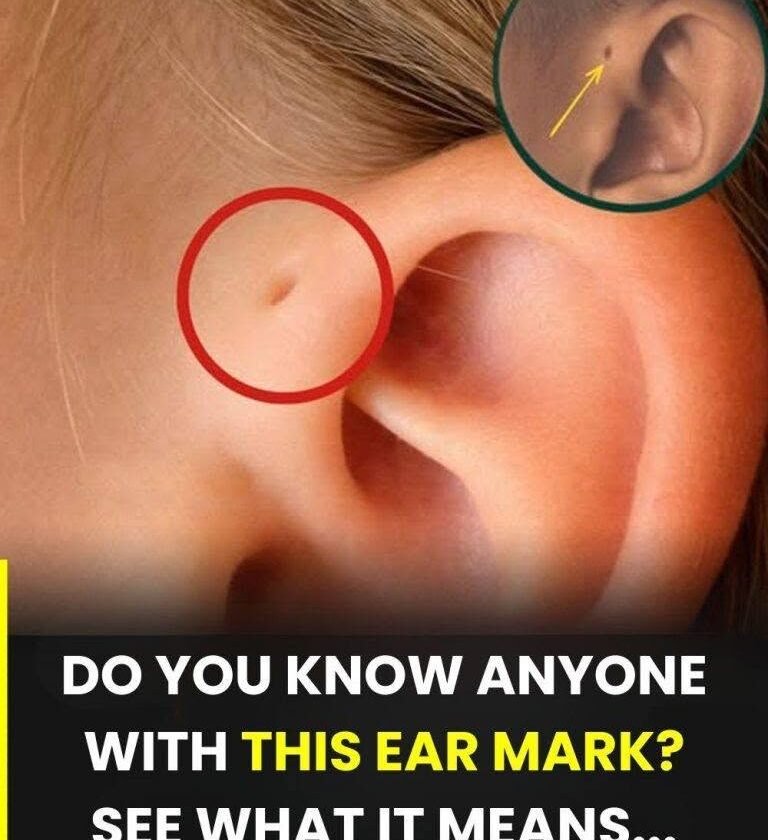
The physical mark you are referring to—a distinct diagonal fold, wrinkle, or line running across the soft lower part of the earlobe—is known in medicine as Frank’s Sign (or the diagonal earlobe crease).
First observed and described by Dr. Sanders T. Frank in 1973, this physical feature has been studied for decades for its potential connection to cardiovascular health.
What Does Frank’s Sign Look Like?
-
It appears as a diagonal line or deep groove running across the earlobe, typically at roughly a 45-degree angle from the tragus (the small cartilage projection in front of the ear canal) toward the outer lower edge.
-
It can show up on one or both ears (unilateral or bilateral) and can range from a shallow, faint indentation to a deep, prominent crease that splits the lobe.
Why Is It Linked to the Heart?
While researchers are still exploring the exact biological mechanism, several leading theories explain why a mark on the ear might correlate with internal cardiovascular stress:
-
Microvascular Breakdown: The earlobe contains tiny, specialized blood vessels and elastic fibers. As generalized vascular aging, loss of elasticity, or atherosclerosis (plaque buildup) occurs throughout the body, the microscopic blood vessels in the earlobe may experience similar micro-infarctions or reduced blood flow, causing the skin to collapse or fold.
-
Systemic Aging and Elasticity: Some researchers view it as an external marker of accelerated biological aging, where the degradation of elastic tissue mirrors the stiffening and hardening of major arterial walls elsewhere in the body.
What Does It Mean for Your Health?
-
It Is a Clue, Not a Diagnosis: Having Frank’s sign does not mean you definitively have heart disease or will suffer a heart attack. Because earlobe creases naturally become more common with advanced age, many older adults have the crease without any underlying cardiac pathology.
-
Statistical Association: Numerous clinical reviews and studies have noted that the presence of a deep, bilateral diagonal crease is statistically more frequent in patients found to have coronary artery disease or a history of stroke. It is considered a non-traditional physical indicator.
-
When It’s Most Notable: A prominent Frank’s sign is generally considered more noteworthy or unique when it appears in younger adults (under age 60), where it may serve as an early visual prompt to look closer at traditional cardiovascular risk factors.
Summary: While an earlobe crease is an interesting physical observation, doctors never use it as a standalone tool to diagnose heart trouble. Instead, true cardiovascular health is evaluated by looking at core risk factors—such as blood pressure, cholesterol levels, blood sugar, family history, and lifestyle—alongside any physical symptoms you might experience