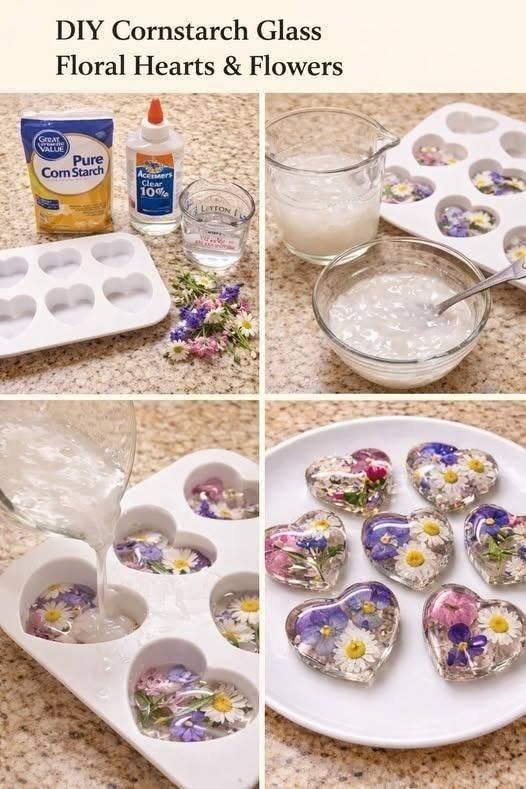
The headline “Cornstarch Glass Floral Hearts & Flowers: The Stunning DIY Craft That Looks Like Stained Glass” is a staple of viral craft and DIY feeds. It usually promises a magical, ultra-cheap kitchen recipe—typically mixing cornstarch, white glue, water, and food coloring in a saucepan—to create translucent, glossy ornaments that look just like cathedral stained glass once they dry.
While these viral craft videos are visually satisfying to watch, anyone who has tried making them at home usually discovers a messy reality: cornstarch crafts tend to warp, crack, attract dust, and turn into a sticky nightmare the moment humidity hits them.
Let’s look at why these viral kitchen recipes behave the way they do, and what actual materials you should use if you want to create durable faux stained glass.
The Science Behind the Cornstarch Craft Fail
Why do these viral cornstarch-and-glue mixtures look like glowing glass on camera, but fall apart in real life?
-
Starch and Moisture Sensitivity: Cornstarch is a polysaccharide (starch). When cooked with water and glue, it creates a flexible, gelatinous film. However, starch is hydrophilic (water-loving). If the humidity in your home rises, or if condensation touches the finished piece, the cornstarch absorbs moisture from the air, rehydrates, swells, and turns cloudy, sticky, or warped.
-
Shrinkage and Cracking: As a thick cornstarch-glue mixture dries, the water evaporates rapidly, causing significant shrinkage. This creates internal stress within the piece, leading to warped edges, curling flowers, or fine cracking across the design.
-
Lack of UV Stability: Standard food coloring used in these DIYs breaks down rapidly when exposed to sunlight. Within a few weeks hanging in a sunny window, those “stunning” vibrant floral hearts fade into pale, sad translucent blotches.
How to Actually Create Faux Stained Glass That Lasts
If you love the aesthetic of translucent floral suncatchers and want to make a craft that stands the test of time (without melting on your windowpane), skip the kitchen pantry and use proper art mediums:
-
Pewter or Lead Liquid Glass Outliners + Glass Paint: Use a specialized peel-off gallery glass or solvent-based glass paint on a clean sheet of clear acetate or picture-frame glass. You pipe out your floral outlines with a dimensional black or metallic liner to mimic lead cording, then fill the sections with transparent glass paint.
-
Resin Art with Tinted Dyes: If you want thick, glossy, glass-like hearts, casting epoxy resin mixed with transparent resin dyes in a silicone mold provides a rigid, waterproof, and UV-stable finish that won’t warp or melt.
-
Alcohol Inks on Yupo Paper or Acetate: For a vibrant, fluid watercolor effect that looks like stained glass, dropping alcohol inks onto transparent acetate or synthetic paper creates stunning, luminous floral patterns that can be sealed with a UV-resistant clear spray.
The Takeaway
Viral kitchen crafts make for great short-form videos, but using cornstarch as a structural casting medium is a recipe for a sticky mess. If you want a lasting piece of faux stained glass, proper craft mediums will keep your floral art looking stunning for years rather than days.