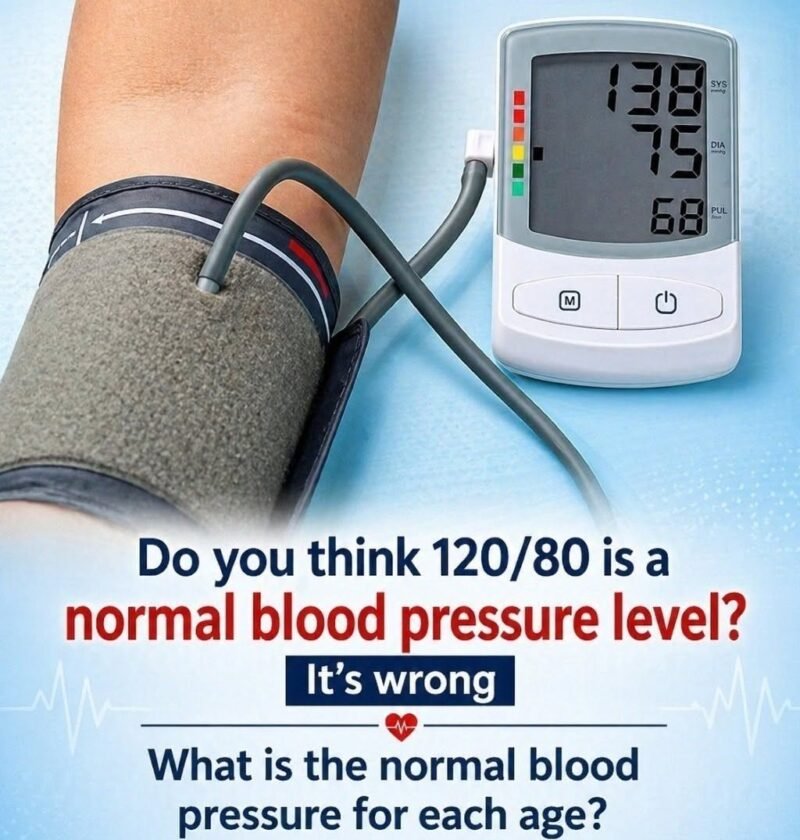
One of the biggest misconceptions in health is that your blood pressure target should automatically go up as you get older. You will often see charts showing that a 70-year-old has a higher average blood pressure than a 20-year-old, leading people to believe that creeping numbers are just a harmless part of aging.
In clinical medicine, there is a vital difference between what is average for an age group and what is healthy.
According to guidelines from major cardiovascular organizations (like the American Heart Association), the ideal, healthy blood pressure target for adults of all ages is less than 120/80 mmHg.
Adult Blood Pressure Categories (Ages 18 and Up)
For all adult age groups, clinical blood pressure readings are categorized as follows:
| Category | Systolic (Top Number) | Diastolic (Bottom Number) | What It Means | |
| Normal | Less than 120 | and | Less than 80 | Ideal cardiovascular range. |
| Elevated | 120–129 | and | Less than 80 | A warning sign; tends to progress to high blood pressure without lifestyle adjustments. |
| Stage 1 Hypertension | 130–139 | or | 80–89 | High blood pressure requiring lifestyle changes and evaluation. |
| Stage 2 Hypertension | 140 or higher | or | 90 or higher | Clearly elevated blood pressure requiring medical management. |
| Hypertensive Crisis | Higher than 180 | and/or | Higher than 120 | Emergency: Seek immediate medical help. |
Why Do Averages Change with Age?
As people age, blood vessels naturally undergo structural changes—primarily arterial stiffness (loss of elasticity in the arterial walls). Because stiff arteries offer more resistance, the top number (systolic pressure, measuring the force when the heart beats) tends to drift upward across decades:
-
Young Adults (18–39): Population averages often sit around 110–120 / 70–78 mmHg. Readings consistently near the upper limit here deserve attention early.
-
Middle Age (40–59): Averages commonly drift toward 120–130 / 74–82 mmHg. This is the critical window where proactive lifestyle changes can prevent chronic hypertension.
-
Older Adults (60+): It is very common for population averages to reach 130–140 mmHg systolic. However, common does not mean safe. An older adult with a reading of 140/85 mmHg still has stage 2 hypertension, which strains the heart, kidneys, and brain over time.
(Note: In treating older adults, physicians sometimes tailor targets individually based on overall health, frailty, or fall risks, but keeping pressure well-managed remains a primary goal to prevent strokes and heart attacks.)
Children and Teens
Blood pressure standards are entirely different for children and adolescents (ages 1 to 19). Because a child’s normal blood pressure depends heavily on their age, height, and gender, pediatricians do not use a single flat number. Instead, they plot readings against specialized growth percentiles. Generally, standard pediatric blood pressures run much lower than adult baselines and scale upward gradually as the child grows.