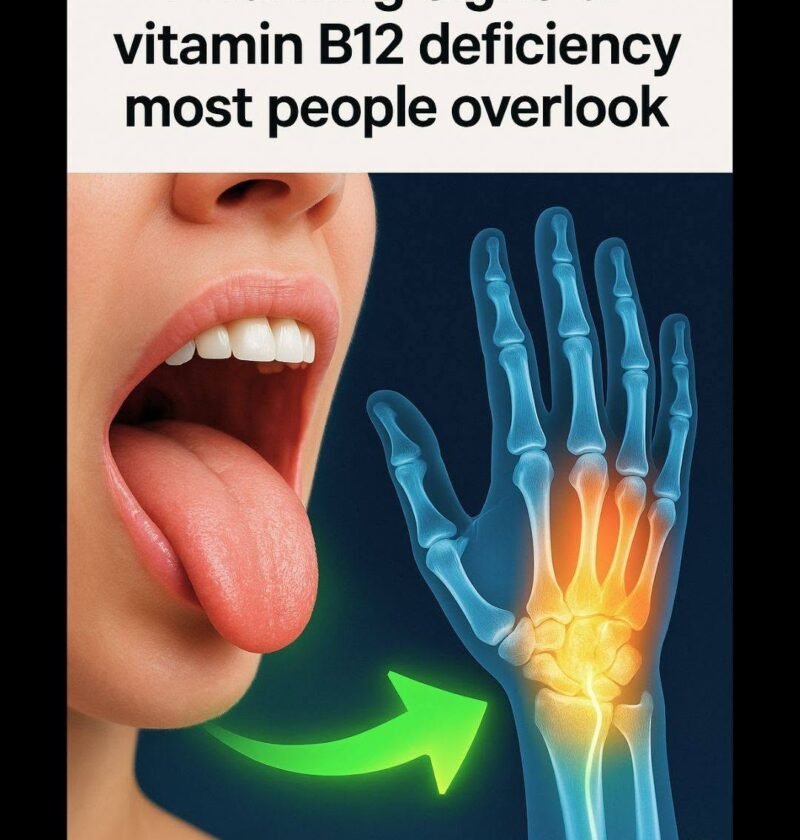
When viral health articles warn about a Vitamin B12 deficiency, they are highlighting a lack of an essential nutrient that your body cannot make on its own. B12 is critical for making red blood cells, keeping your nervous system functioning properly, and synthesizing DNA.
Because a deficiency develops slowly over months or even years, your body often sends subtle warning signals before turning into a full-blown medical issue like megaloblastic anemia or nerve damage.
4 Alarming Symptoms of Vitamin B12 Deficiency
-
1. Profound Fatigue and Muscle Weakness:
-
What happens: Without enough B12, your body cannot produce adequate healthy red blood cells to carry oxygen efficiently through your tissues. This leads to megaloblastic anemia, leaving you feeling utterly exhausted, breathless with mild exertion, and chronically weak no matter how many hours you sleep.
-
-
2. Tingling, Numbness, and “Pins and Needles” in Your Hands and Feet:
-
What happens: Vitamin B12 is vital for maintaining and repairing the protective myelin sheath that insulates your nerve fibers. When B12 drops too low, nerve signaling misfires, resulting in persistent numbness, tingling sensations in the extremities, or a feeling of walking on cotton.
-
-
3. Brain Fog, Memory Lapses, and Mood Changes:
-
What happens: Because your nervous system relies heavily on B12 for cognitive function and neurotransmitter synthesis, a deficiency can manifest as difficulty concentrating, forgetfulness, irritability, or even mood disturbances that mimic anxiety or depression.
-
-
4. A Smooth, Sore, Red Tongue (Glossitis) and Mouth Ulcers:
-
What happens: Rapidly dividing cells—like those in your mouth and tongue—are heavily impacted by low B12. Your tongue may become swollen, inflamed, smooth (as the tiny papillae wear down), or painful, accompanied by frequent mouth ulcers or a burning sensation.
-
⚠️ Important Things to Know About B12 Deficiency
-
Who is most at risk? B12 is found almost exclusively in animal products (meat, fish, eggs, dairy). Consequently, vegans and vegetarians are at higher risk. Additionally, older adults often develop deficiencies due to decreased stomach acid production, which is required to absorb B12 from food. Certain medications (like long-term acid reflux drugs or metformin) can also block absorption.
-
Get Tested First: Before buying high-dose supplements, ask your doctor for a simple blood test to check your serum B12 and methylmalonic acid (MMA) levels. Correcting a severe deficiency often requires specific guidance, sometimes including B12 injections if your digestive tract cannot absorb oral vitamins properly.