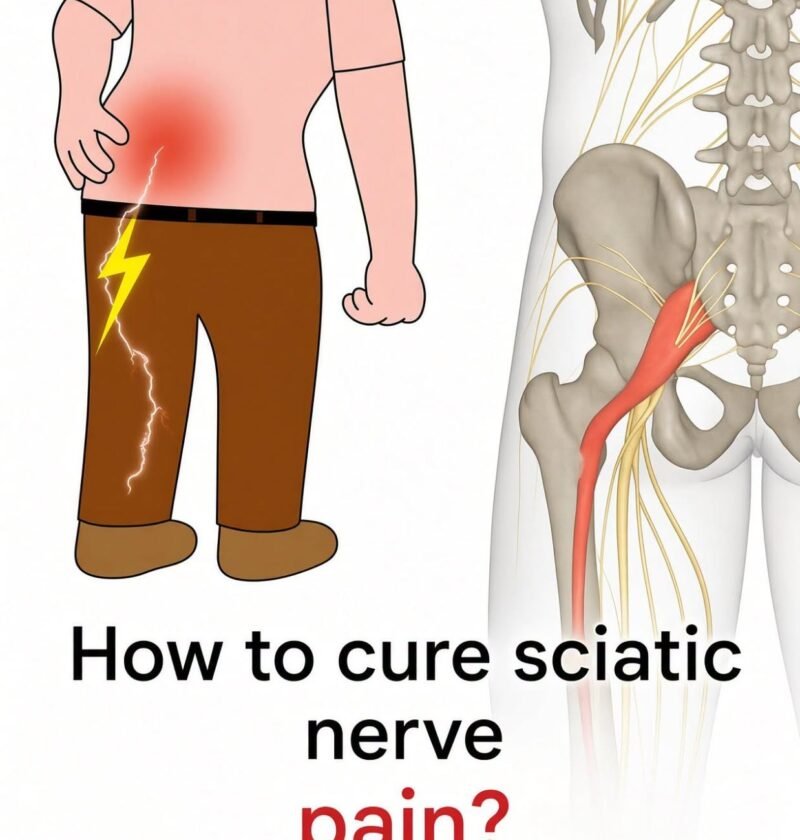
When viral health headlines promise 3 quick exercises to “cure” sciatica in minutes, they often oversimplify a condition that can stem from several different spinal structures. Sciatica isn’t a disease in itself; it is a description of symptoms—specifically, sharp, shooting pain, numbness, or tingling that travels from your lower back, through your glutes, and down the path of the sciatic nerve into your leg.
Because the sciatic nerve is the largest nerve in your body, relieving its irritation requires understanding what is compressing it. Whether the pressure comes from a bulging lumbar disc or a tight muscle deep in your hip, targeted, gentle movement is one of the most effective ways to calm the inflammation.
Here are 3 practical, evidence-based exercises to help relieve sciatica pain, along with how to know which variation fits your anatomy:
1. The Seated Figure-4 Stretch (For Piriformis Syndrome)
-
Best For: Sciatica caused by tightness or spasms in the piriformis muscle deep in the buttock, which can pinch the sciatic nerve as it passes underneath or through it.
-
How to Do It:
-
Sit upright in a sturdy chair with both feet flat on the floor.
-
Cross your right ankle over your left knee, creating a “figure-4” shape.
-
Keep your spine straight and gently hinge forward at your hips, leaning your chest toward your shin until you feel a comfortable, deep stretch in your right glute/hip.
-
Hold for 20 to 30 seconds, breathing deeply, then switch sides. Repeat 2 to 3 times per side.
-
-
The Clinical Rule: If leaning forward increases shooting pain down your leg, stop immediately—your pain may be disc-related rather than muscle-related, and you should switch to a different movement.
2. Gentle Knee-to-Chest Stretch (For Lumbar Decompression)
-
Best For: Opening up the lower back vertebrae and relieving mild nerve root compression caused by lumbar strain or joint stiffness.
-
How to Do It:
-
Lie flat on your back on a comfortable mat with your knees bent and feet flat on the floor.
-
Slowly bring one knee up toward your chest, clasping your hands around your shin or thigh.
-
Gently pull it closer until you feel a mild stretch in your lower back and glute. Keep your opposite foot resting on the floor.
-
Hold for 20 to 30 seconds, lower it down, and repeat with the other leg. You can also pull both knees up simultaneously if it feels comfortable.
-
3. Prone Press-Up / Cobra Pose (For Disc-Related Sciatica)
-
Best For: Sciatica caused by a posterior disc bulge (where the cushioning disc presses backward against the nerve root). This movement uses a principle called lumbar extension to guide the disc material away from the nerve.
-
How to Do It:
-
Lie face down on your stomach with your legs straight and your hands placed flat on the floor directly under your shoulders (like you’re about to do a push-up).
-
Keeping your hips and pelvis relaxed and resting against the floor, gently push up with your arms to lift your upper chest off the ground, looking straight ahead.
-
Go only as high as your lower back comfortably allows without sharp pain. Hold for 2 to 3 seconds, then lower yourself back down.
-
Repeat for 8 to 10 slow repetitions.
-
-
The Clinical Rule: This exercise should centralize your pain (making it move out of your leg and back toward your lower back). If it causes pain to shoot further down your leg, stop immediately.
Important Safety Tips for Sciatica Exercises
-
Never “Push Through” Sharp Pain: Stretching should feel like a deep, relieving pull, never a sharp, electric shock. If an exercise intensifies shooting pain down your leg, back off immediately.
-
When to See a Doctor: While mild sciatica often improves with gentle movement and anti-inflammatory care, you should seek immediate medical evaluation if you experience progressive leg weakness (like foot drop, where you can’t lift your toes), loss of bowel or bladder control, or unrelenting numbness in the groin area (signs of Cauda Equina Syndrome, a true medical emergency).
Are you or someone you know currently dealing with shooting sciatica pain or lower back discomfort?