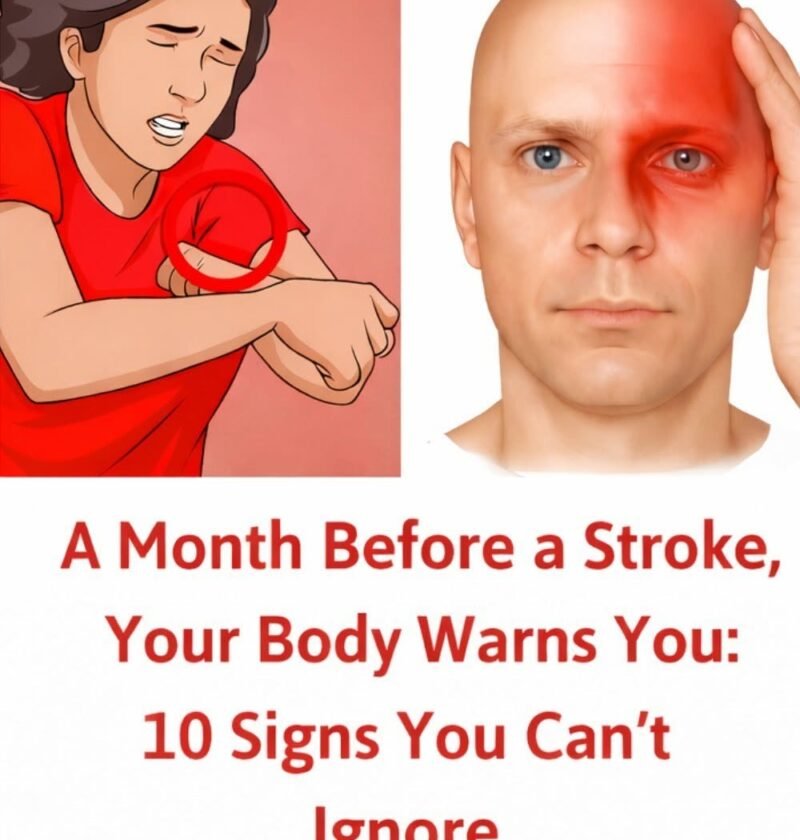
Catchy headlines often claim that a stroke gives exact warning signs “a month in advance.” In medical reality, acute strokes happen suddenly when blood flow to a part of the brain is abruptly blocked or a blood vessel ruptures.
However, neurologists and vascular specialists recognize that Transient Ischemic Attacks (TIAs)—often called “mini-strokes”—or subtle cardiovascular strain can occur days or weeks before a major stroke. Recognizing these precursor signals is crucial because they serve as a critical window to prevent a full-scale medical emergency.
Here are 10 important neurological and vascular warning signs that should never be ignored:
1. Transient One-Sided Weakness or Numbness
-
What it feels like: A sudden, temporary heavy feeling, weakness, or “pins and needles” down one entire vertical half of the body (such as the right arm and right leg simultaneously) that passes after a few minutes.
-
Why it happens: This is a classic hallmark of a TIA, where a temporary clot cuts off blood flow to a specific motor strip in the brain before dissolving on its own.
2. Sudden Slurred Speech or Finding Words Difficult
-
What it feels like: A brief episode where your speech sounds thick, slurred, or you struggle to articulate thoughts or understand what others are saying.
-
Why it happens: Temporary ischemia in the language centers of the brain (such as Broca’s or Wernicke’s areas) temporarily disrupts speech processing.
3. Sudden, Unexplained Loss of Balance or Dizziness
-
What it feels like: A sudden, heavy bout of unsteadiness, vertigo, or an inability to walk straight that feels entirely different from routine lightheadedness.
-
Why it happens: Disruption in blood flow to the cerebellum or brainstem—the areas controlling coordination and spatial equilibrium—can trigger sudden balance failures.
4. Brief, Sudden Vision Changes in One Eye
-
What it feels like: A temporary blurring, double vision, or a dark “shade” pulling down over the vision of one eye.
-
Why it happens: The ophthalmic artery branches directly from the internal carotid artery, making the eyes an early mirror of vascular or carotid plaque instability.
5. Sudden, Severe “Thunderclap” Headache
-
What it feels like: A blinding, excruciating headache that strikes with maximum intensity instantly, completely out of nowhere.
-
Why it happens: This type of sudden headache can signal small sentinel leaks or rising pressure associated with an impending hemorrhagic event.
6. Sudden Confusion or Cognitive Fog
-
What it feels like: A brief, uncharacteristic episode of disorientation where you feel suddenly confused about your surroundings, time, or familiar routines.
-
Why it happens: Widespread or multi-area micro-vascular disruptions can temporarily impair higher-level executive processing.
7. Sudden Facial Droop or Asymmetry
-
What it feels like: A brief feeling of stiffness or numbness on one side of the face, sometimes noticed when looking in the mirror or when smiling.
-
Why it happens: Mild nerve pathway deprivation from reduced blood flow causes temporary loss of tone in the facial muscles.
8. Unexplained Swallowing Difficulties (Dysphagia)
-
What it feels like: A sudden, unexpected choking sensation or difficulty swallowing saliva or liquids smoothly.
-
Why it happens: The cranial nerves governing the complex throat and swallowing muscles are highly sensitive to changes in cerebral perfusion.
9. Sudden Clumsiness or Fine Motor Loss in the Hands
-
What it feels like: Suddenly dropping items, struggling to button a shirt, or finding that one hand refuses to cooperate with precise movements.
-
Why it happens: Focal ischemia in the cerebral cortex can temporarily disrupt fine motor control mapping.
10. Persistent Uncontrolled Blood Pressure Spikes
-
What it feels like: Frequent, unexplained episodes where blood pressure surges dramatically alongside a pounding heartbeat or mild head pressure.
-
Why it happens: Chronic hypertension is the single greatest underlying driver of vascular wear and tear, and erratic blood pressure control often precedes major cerebrovascular events.
The Golden Rule of Brain Health
If you or someone nearby ever experiences sudden neurological symptoms—even if they completely disappear after 10 or 15 minutes—do not brush them off as fatigue. A TIA is a medical emergency and a warning shot from the cardiovascular system. Seeking immediate medical evaluation can allow doctors to clear blockages, adjust medications, and drastically lower the risk of a permanent stroke.
Are you reviewing these signs out of general health awareness, or have you or a loved one experienced any unusual neurological shifts recently?