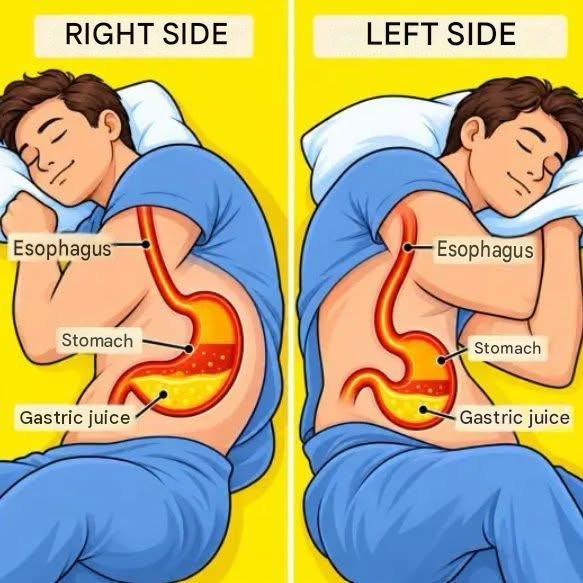
While left-side sleeping often gets crowned as the ultimate posture for digestion, sleeping on your right side has its own unique physiological impacts—some surprisingly beneficial, and others that might make you want to shift positions.
Here is what actually happens to your body when you snooze on your right side and when it’s time to roll over.
1. What Right-Side Sleeping Does Well
-
Heart Relief and Comfort: For individuals with certain types of heart conditions or congestive heart failure, sleeping on the right side is often more comfortable. Gravity pulls the heart slightly away from the chest wall, minimizing sensations of palpitations or discomfort that can sometimes occur when lying flat or on the left side.
-
Spinal Alignment (When Supported): Just like left-side sleeping, laying on your right side keeps your spine relatively neutral compared to stomach sleeping, provided you use a supportive pillow for your neck and place one between your knees.
2. The Major Drawback: Acid Reflux and Heartburn
The most significant physiological downside to right-side sleeping comes down to basic anatomy:
-
The Angle of the Stomach: Your stomach sits on the left side of your upper abdomen, and the junction where your esophagus connects to your stomach sits below the level of gastric acid when you lie on your right.
-
The Result: Gravity makes it much easier for stomach acid to leak upward past the lower esophageal sphincter. If you struggle with GERD, chronic acid reflux, or ate a heavy meal late at night, sleeping on your right side is a fast track to waking up with a burning throat.
3. Other Notable Effects
-
Pregnancy Considerations: While side-sleeping in general is recommended during pregnancy, doctors strongly advise expecting mothers to favor their left side. Sleeping on the right side can place pressure on the inferior vena cava—the major blood vessel returning blood from the lower body to the heart—potentially reducing circulation to the fetus.
-
Facial Wrinkles and Compression: Just like any side-sleeping position, pressing half of your face directly into a pillow night after night can contribute to “sleep lines” and accelerated facial skin crepiness on that specific side.
When Should You Change Position?
You should consider rolling over or adjusting your posture if:
-
You wake up with a sour taste or heartburn: A sure sign that your stomach acid is taking advantage of the right-side angle. Switch to your left side or prop your upper body up with a wedge pillow.
-
You are pregnant or recovering from cardiovascular strain: Sticking to the left side optimizes blood flow and reduces pressure on major organs.
-
You experience shoulder tightness: If your bottom shoulder starts aching from bearing your body weight, alternating sides or using a softer mattress topper can help.
💡 The TakeawayIf your digestion is bulletproof and you find right-side sleeping the most comfortable way to doze off, your body is doing just fine! But if you’re prone to acid reflux, making the shift to your left side can bring instant relief.
Do you tend to stay in one position all night, or do you toss and turn between your back and sides while sleeping?