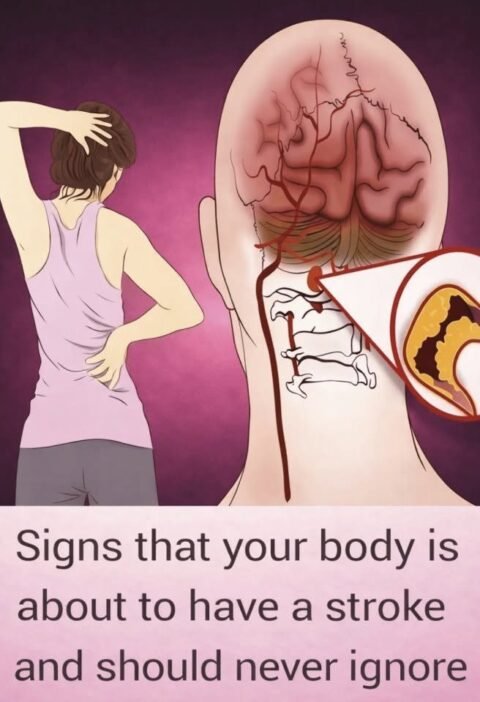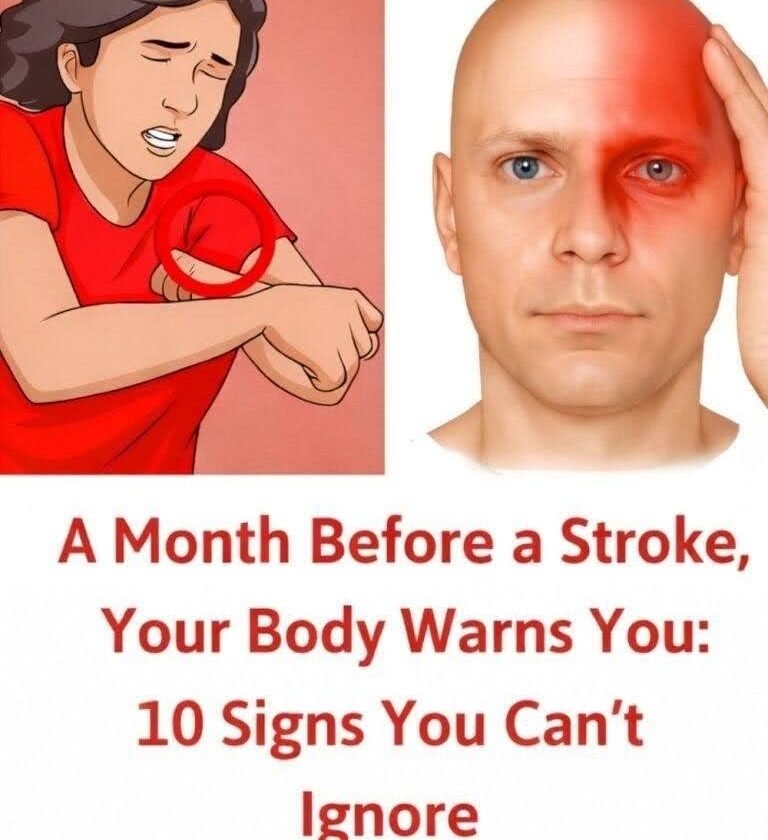
If you’re asking whether the claim “your body warns you one month before a stroke” is medically accurate: not exactly. There is no reliable set of 10 symptoms that predicts a stroke one month in advance. However, some people experience a transient ischemic attack (TIA)—a temporary episode with stroke-like symptoms—which can warn of an impending stroke and requires urgent medical assessment. CDC+1
Warning signs you should never ignore
Sudden episodes of:
-
Numbness or weakness, especially on one side of the face, arm, or leg.
-
Face drooping or an uneven smile.
-
Speech becoming slurred, confused, or difficult to understand.
-
Difficulty understanding speech.
-
Sudden vision changes, including blurred, double, or lost vision.
-
Sudden dizziness or loss of balance/coordination.
-
Sudden difficulty walking.
-
Sudden severe headache without an obvious cause.
-
Temporary paralysis or marked weakness on one side.
-
Symptoms that disappear after a few minutes. This can be a TIA and is not reassuring—the symptoms can resolve while the underlying risk remains. www.stroke.org+1
Remember B.E. F.A.S.T.
B — Balance loss
E — Eye/vision changes
F — Face drooping
A — Arm weakness
S — Speech difficulty
T — Time to seek emergency help
If these symptoms are happening now, don’t wait to see whether they improve. Call your local emergency service and note the time the symptoms started. Even if they completely disappear, a possible TIA needs urgent medical evaluation. CDC+1
Also, symptoms such as ordinary fatigue, headaches, poor sleep, or general dizziness by themselves are not reliable evidence that a stroke is coming. The important pattern is usually sudden neurological change.